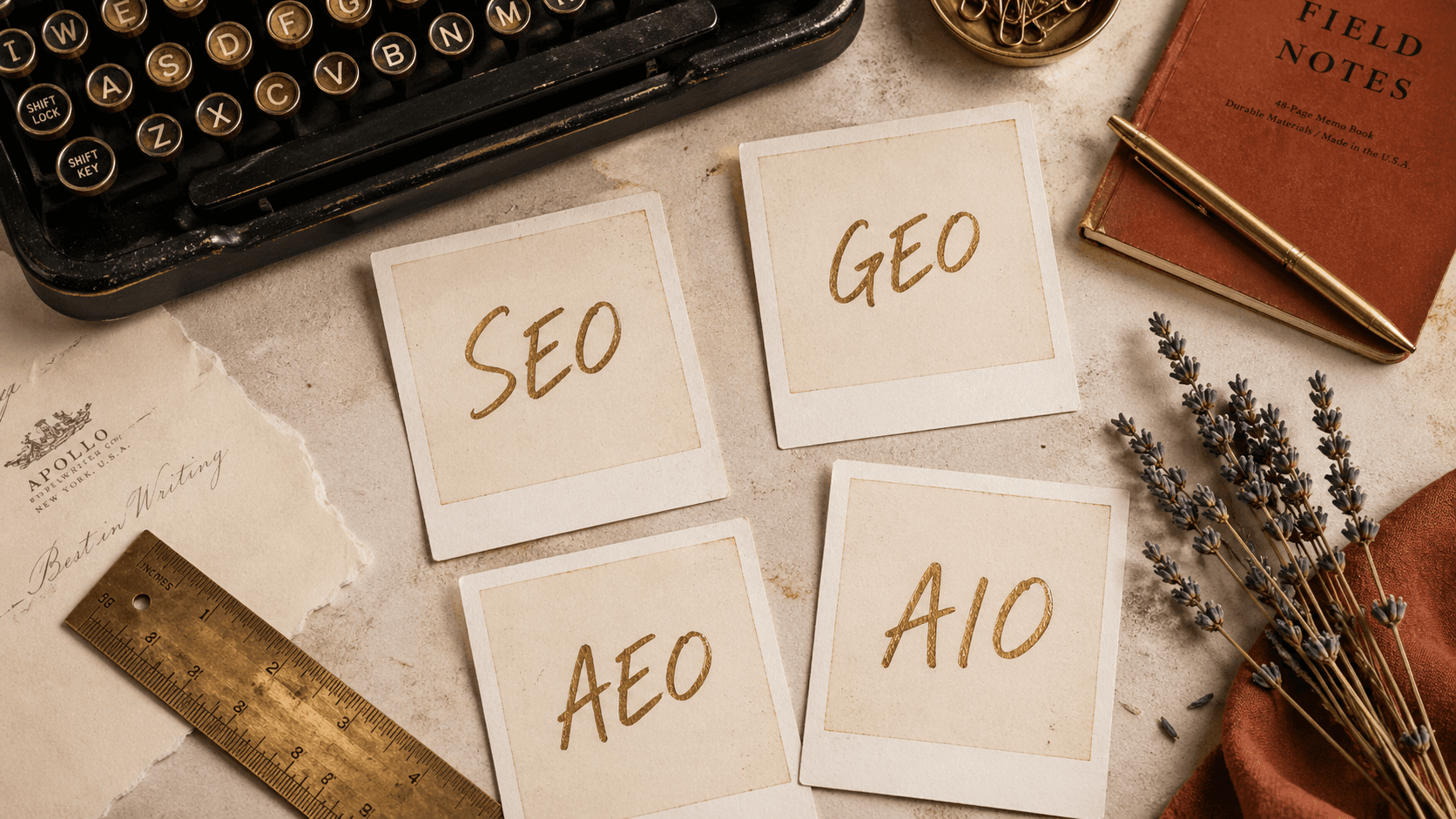
Every two weeks, a new acronym shows up in your inbox from someone trying to sell you something. SEO. GEO. AEO. AIO. AI-SEO. LLMO. The letters keep multiplying like a bad sequel.
Most of them describe a real thing. A few of them describe the same real thing with different branding. And a couple of them are vendor inventions that exist mainly to justify a retainer.
This post is the cheat sheet. If you read nothing else this month, read this. You will know what every consultant who emails you is actually offering, and what they are not.
SEO: Search Engine Optimization
The original. The one you have been hearing about since the iPhone launched. SEO is the practice of getting your website to rank well in traditional search engine results. Google's ten blue links, plus Bing, plus the few other search engines that still exist.
SEO covers things like:
- Keywords and on-page content
- Backlinks from other websites
- Page speed and technical health
- Meta tags, sitemaps, internal linking
SEO still matters in 2026. It is the floor, not the ceiling. If your SEO is broken, your AI visibility will be broken too, because every AI engine reads the same web Google reads.
GEO: Generative Engine Optimization
This is the term Prompting Logic uses, and it is the one we recommend. GEO is the practice of optimizing for AI search engines that generate answers. ChatGPT, Google AI Overviews, Perplexity, Gemini, Claude.
The "generative" part is the giveaway. These engines do not return a list. They generate a response. Your job in GEO is to make sure your business shows up inside the response, by name.
GEO work includes:
- LocalBusiness, Service, FAQPage, and Review schema
- Entity consistency across your site, GBP, and directories
- FAQ-style content that AI models can quote directly
- llms.txt and crawler accessibility
- Citation and review velocity
For the long version, read What is GEO? and the 8 AI visibility signals every home and design business website needs in 2026.
AEO: Answer Engine Optimization
AEO predates GEO by a few years, originally coined for voice assistants and featured snippets. The "answer engine" was Google trying to answer your question directly inside the search results page (think the box at the top that quoted a specific paragraph).
AEO and GEO overlap heavily in 2026. The work is mostly the same: structured data, clear question-and-answer content, schema markup. Some practitioners use AEO and GEO interchangeably. Others use AEO specifically for the answer box on Google, and GEO for the AI products that generate longer answers.
If a vendor sells you AEO and another sells you GEO, ask both of them what specific deliverables you get. If the lists look similar, they are doing similar work under different brand names.
AIO: AI Optimization (or AI Overviews Optimization)
AIO is the newest term and the least settled. It usually means one of two things:
- AI Optimization in the broad sense, optimizing for any AI surface where your business might appear.
- AI Overviews Optimization, specifically targeting the boxes Google AI Overviews generates at the top of search results.
The second is a subset of the first. Most people using AIO mean some flavor of "optimize for AI search," which is functionally GEO with a different label.
If you see AIO in someone's marketing, your follow-up question is "AI Overviews specifically, or all AI surfaces?" The answer tells you whether they actually understand the discipline.
The four-acronym cheat sheet
| Acronym | What it means | Where it shows up |
|---|---|---|
| SEO | Search Engine Optimization | Traditional Google ranked results |
| GEO | Generative Engine Optimization | ChatGPT, Perplexity, Gemini, AI Overviews |
| AEO | Answer Engine Optimization | Google answer boxes, voice assistants |
| AIO | AI (Overviews) Optimization | Often a synonym for GEO |
Bonus terms you will hear in the wild
A few more letters worth recognizing:
- LLMO (Large Language Model Optimization). A rebrand of GEO. Same work, fewer syllables.
- SGE (Search Generative Experience). Google's internal name for the project that became AI Overviews. Mostly retired as a public term.
- E-E-A-T (Experience, Expertise, Authoritativeness, Trustworthiness). Google's quality framework, still relevant. AI engines weight similar signals.
- Local SEO. The slice of SEO focused on map results and "near me" queries. Still very real, still very important, increasingly overlaps with GEO.
What you should actually buy
If a consultant pitches you an AI search package, the question to ask is not which acronym they use. It is which deliverables you get and on what timeline. Look for the specifics: schema installed on which pages, GBP optimized to which level, FAQ pages built with which structure, citations built across which directories.
The acronym is the box. The deliverables are what is inside the box. Our service page spells out exactly what we install at each level so you can compare apples to apples.
You do not need to memorize four acronyms. You need to know that AI search is a real channel, the work to win in it is specific, and your business gets one shot at being the name that AI cites.
Curious how your business is currently labeled across these four surfaces? A free Quick Audit tells you in plain English where you show up today.