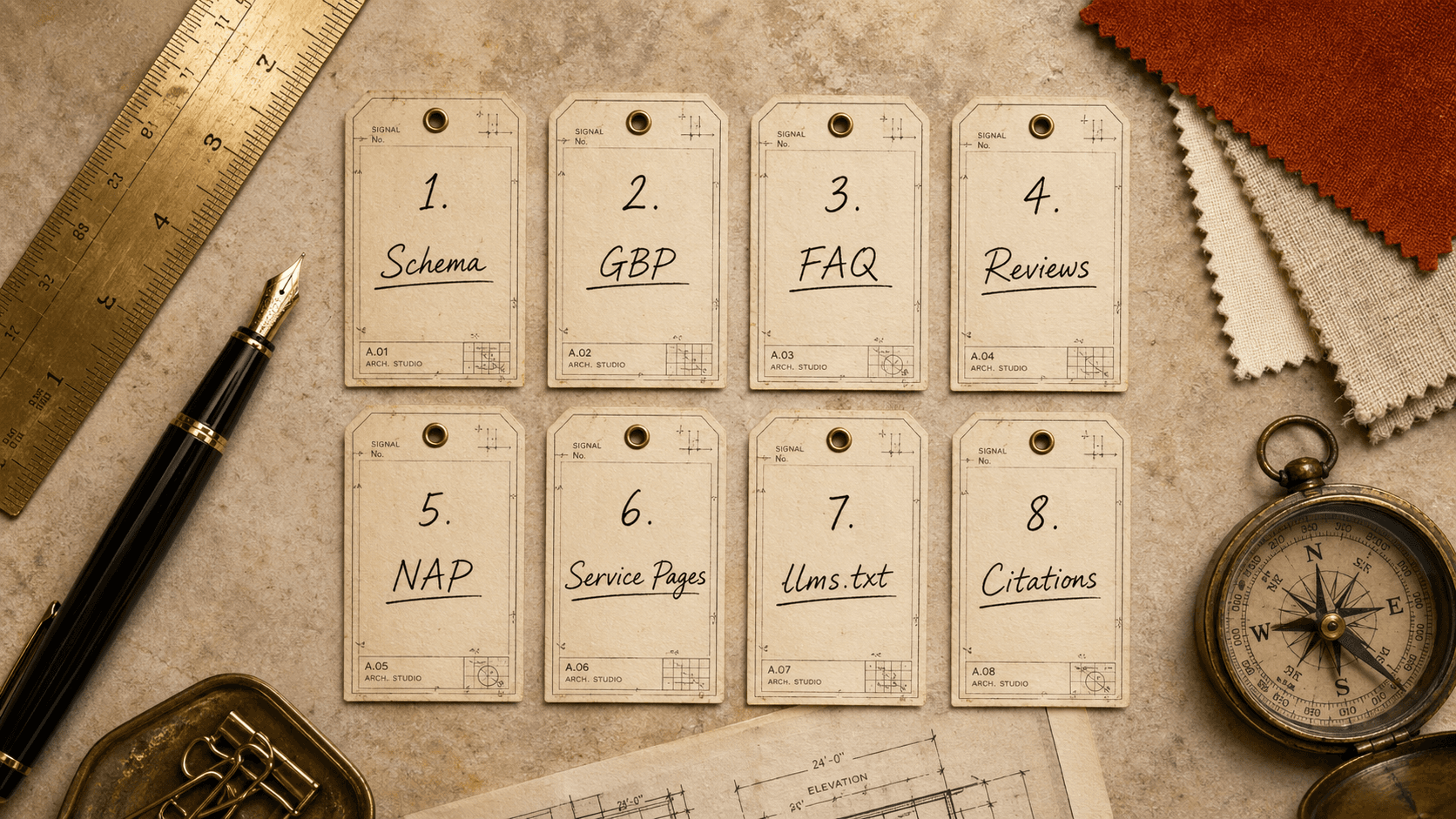
When we run a Prompting Logic Full Audit, we install eight specific fixes. They are not the only things that matter for AI visibility, but they are the fixes with the highest leverage for the least work. If you do nothing else this quarter, do these eight.
1. LocalBusiness schema on the home page
Schema is invisible structured data embedded in your HTML that tells search engines and AI models what kind of entity your page represents. LocalBusiness is the parent type for any business with a physical location or service area. It declares your name, address, phone, category, hours, and service area in a format every AI model can parse in a single pass.
Most home and design business websites have no schema at all. Installing LocalBusiness schema is usually the single biggest-impact fix in any audit. AI models move from "we can't confirm this business is real" to "we can cite this business by name" after this one change.
2. Service schema on every service page
Every individual service you offer should have its own page, and that page should have Service schema declaring what the service is, who provides it, where it is available, and what it typically costs. Service schema is how AI models know, for example, that you do kitchen remodels in the Raleigh area for a certain price range.
Without this, AI has to infer your services from body copy, which it does badly. With it, AI can confidently recommend you for the exact query a customer asks.
3. FAQPage schema on a dedicated FAQ page
FAQ content in the format of question-and-answer pairs is the format AI models most like to cite directly. Wrapping it in FAQPage schema signals to the model that this is structured Q&A content, not regular prose. The result is that your answers get pulled into AI responses as direct quotes, with attribution to your site.
Pick ten questions your customers actually ask on discovery calls. Write a clean two-to-four-sentence answer for each. Wrap them in FAQPage schema. Ship.
4. Review schema on testimonials
A testimonials page is social proof. A testimonials page wrapped in Review and AggregateRating schema is social proof that shows up as star ratings in Google search results and as credibility signals in AI recommendations.
Tools like Google are much more confident recommending a business with 47 reviews averaging 4.9 stars than one with "great reviews" mentioned in body text. Schema is how you make that count.
5. Service area pages for every city you serve
If you serve five cities, you need five landing pages, each one targeting a specific query like "kitchen remodeler in [city]." Generic "we serve the Triangle area" copy on the home page does not rank and does not get cited by AI.
Each city page should be at least 400 words, include the city in the headline and in schema, and mention two or three nearby neighborhoods or landmarks. This is table stakes for AI-local visibility.
6. Google Business Profile completeness
GBP is the single strongest local AI signal, and it is free. Every field should be filled: categories (primary and all relevant secondary), services list, hours, photos refreshed monthly, Q&A populated with real answers, posts every two to four weeks.
Google treats GBP completeness as a trust score. AI models treat it as ground truth for your business facts. It is the one asset you own that you can upgrade in an afternoon for $0.
7. llms.txt at the root of your domain
The llms.txt file is a new convention, similar to robots.txt, that tells AI crawlers specifically how to understand your site. It lists your core pages, describes your business in a model-friendly format, and flags content you want cited.
Adoption is early, but the major AI products are increasingly honoring it. Installing llms.txt now is a low-cost early bet that compounds as adoption grows.
8. A consistent NAP (name, address, phone) across every directory
Your business name, address, and phone number should be identical (character-for-character) across your website, GBP, Yelp, Houzz, Bing Places, Apple Maps, and every industry-specific directory. Inconsistency is the single most common signal of "low-confidence entity" that makes AI refuse to cite you.
A citation audit finds every inconsistency. Fixing them is boring and slow but absolutely necessary.
Doing all eight
You can install all eight of these yourself if you are technical. You can also pay Prompting Logic $499 for the Full Audit, which delivers every one of them implemented and deployed within 48 hours, plus a full AI visibility report and a 90-day roadmap for what to do next.
Either way, the point is this: AI visibility is not mystery work. It is a specific list of fixes. Do the list, and you go from invisible to citable. Skip the list, and your competitors who do it will own the AI recommendation side of your market for years.
If you want the full list applied to your actual site, request a free Quick Audit. It is the easiest way to find out which of the eight you already have and which are missing.