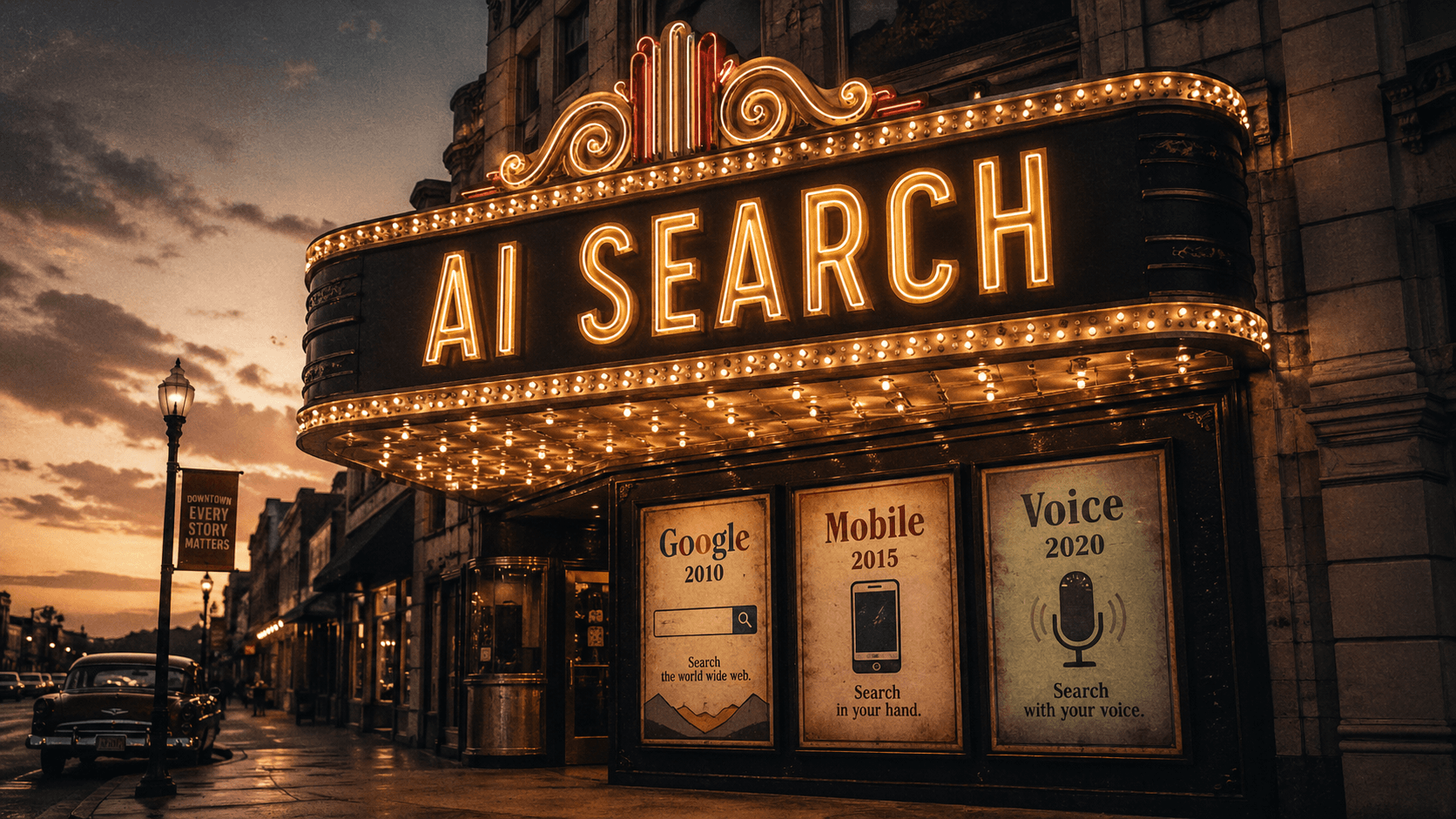
If 2024 was the trailer for AI search, 2025 was Act 1. The studio raised the budget. New stars appeared. Old characters got rewritten. And by the time the credits rolled on December 31st, the franchise had quietly replaced the one Google built between 2003 and 2020.
For home and design business owners, the question is no longer whether AI search matters. It is whether you booked your seat for Act 2.
Here is what actually changed in the last twelve months, and what it means for businesses that depend on local customers finding them online.
1. Google AI Overviews became the default, not the experiment
A year ago, Google AI Overviews appeared at the top of some searches some of the time. The boxes were small, the answers were short, and the disclaimer at the bottom (this is experimental) made it feel optional.
That language is gone. The boxes are larger. They show up on most local-intent queries, including the ones home and design businesses care about: "best [service] near me," "how much does [service] cost," "what to look for in a [service]." They cite businesses by name and link out to fewer of the traditional ten blue links.
If your business is not one of the names cited, the customer reads the answer, scrolls past the link list (often without scrolling), and either clicks one of the cited businesses or asks a follow-up question. The space below the AI Overview is no longer the page anyone reads first.
2. ChatGPT moved from "AI assistant" to "search engine"
The plot twist of 2025 was OpenAI quietly turning ChatGPT into a daily search habit. Browsing got faster. The Search mode became default for many users. The mobile app launched a search-bar style interface that competes directly with Google.
For local queries, ChatGPT now reads the live web before answering. It is reading your site. It is reading your reviews. It is reading the directories you forgot you had a profile on. And it is making a decision, in real time, about whether to recommend you.
The frame to keep in your head: every time a customer asks ChatGPT for a recommendation, your business is auditioning. The audition lasts about a second.
3. Perplexity started showing up where it should not
Perplexity was a niche product in 2023. By the end of 2025 it was a daily tool for designers, contractors, and decision-makers researching service providers. People we would not have predicted, like contractors using Perplexity to research suppliers, are now using it to research peers and competitors.
It matters because Perplexity is the most aggressive about citing specific businesses by name with links. If your competitor shows up in a Perplexity answer and you do not, the customer can click directly through. There is no Google Map results alternative path. The AI either named you or it did not.
4. Apple Intelligence quietly entered the chat
The iOS rollout of Apple Intelligence brought ChatGPT-powered answers directly into Siri, Spotlight, and Safari summaries. Most owners we talk to had no idea this happened. Their customers absolutely did.
The practical consequence is that search on a customer's phone is now a multi-product experience. Siri might answer the first time. Spotlight might surface a result the second time. The third time the customer might open Google. Each of those surfaces is reading a different signal mix, but they are all reading the same web.
5. Schema and structured data went from "nice to have" to "the price of admission"
One year ago, you could rank reasonably well without LocalBusiness schema. By the end of 2025, the businesses cited in AI answers were nearly all schema-equipped. The businesses without it were invisible.
This is the single most expensive shift for businesses that did not see it coming. Search no longer reads your home page like a person. It parses the structured data you embedded for it. Skip the structured data, and you do not get parsed at all.
For a primer, see the 8 AI visibility signals every home and design business website needs in 2026.
What it means for 2026
If you are a home, design, or decor business owner, the calendar year ahead has a clear plot:
- The customers who used to find you on page 1 of Google are now meeting you (or not meeting you) inside an AI answer.
- The fixes required to show up in AI answers are specific, technical, and unsexy. They are not new platforms or new ad spend.
- The window where the foundational work is cheap to install is closing as more competitors do it.
- AI Overviews became the default Google experience for local queries.
- ChatGPT and Perplexity now read the live web and recommend businesses by name.
- Apple Intelligence put AI answers in front of every iPhone user, often without them realizing it.
- Schema and GBP completeness went from optional to mandatory.
- The competitive moat shifted from old backlinks to clean structured data.
The franchise is not slowing down. The next twelve months will get weirder, faster, and more competitive. The good news is that you do not need to predict everything. You need a foundation that AI engines can read, trust, and cite. Once that foundation is in, the rest is steady-state work.
Need a starting point? See our explainer on Generative Engine Optimization or why your Google rankings no longer protect you from AI search.
Want to see exactly where your business stands as 2026 unfolds? Request a free Quick Audit and we will show you what AI knows about you today.